
如何执行有效的基于 B2B SaaS 帐户的营销活动
已发表: 2021-06-16基于客户的营销 (ABM)是一种专注的增长战略,其中营销和销售合作为一组相互识别的高价值客户创造个性化的购买体验。
这种 B2B 外展策略可以帮助您的公司进入新市场、攻击新的垂直领域,甚至为即将举行的活动或产品发布吸引潜在客户。
然而,要执行有效的活动,ABM 需要大量的准备、多个部门之间的协调以及精确的时间执行。 如果没有对这些领域给予适当的关注,你最终会陷入一场无效的竞选活动,花费太多的钱,而对你出错的地方几乎没有洞察力。
在 Kalungi,我们看到许多 B2B SaaS 公司希望通过有效的 ABM 活动来加强他们当前的营销工作。 但是,对于经验很少或没有经验的公司来说,将基于客户的营销活动从无到有发展到全面的潜在客户开发工作可能会令人生畏。
如您所见,ABM 并不是一根魔杖。 相反,它是人员、流程和技术的强大组合,如果以智能方式部署,它将胜过贵公司的所有其他需求生成计划。
如果您的 B2B SaaS 公司正在考虑开展 ABM 活动来推动和支持业务增长,请继续阅读以了解如何实施成功的活动。
ABM 不仅仅是对外营销
是否应该真正将入站驱动的基于帐户的营销视为 ABM 尚有争议。 然而,很明显,现代的 ABM 方法需要在协调方法中结合入站和出站元素。 基于客户的营销传统上被视为 B2B 对外销售的总体战略。 然而,更复杂的观点将 ABM 视为一种包含出站和入站营销的有针对性的策略。 更复杂的 B2B 企业也有将基于帐户的营销策略纳入其业务模型的空间。
好消息是,启动 SaaS ABM 不需要您拔掉现在正在做的所有事情并从头开始。 相反,它是一种与您现有的需求生成流程一起工作的补充策略——与他们共享资源、数据、工具和技术。
基于帐户的营销概述
ABM 流程采用典型的销售/营销漏斗并将其翻转过来,从最适合产品或服务但可能尚未准备好购买的潜在客户开始。 然后,该策略将在整个销售周期中培养他们,并通过推荐和口碑扩大其潜在客户。

左侧的销售漏斗; 右侧的 ABM 漏斗
因此,ABM 活动不会向大量受众发送电子邮件和广告并查看谁决定“选择加入”并表现出兴趣,而是选择一小群候选人,他们可能甚至不了解您的产品,但他们是完美的适合它。 找到这些有前途的联系人后,您可以通过搜索与他们具有相似品质的其他联系人或帐户来扩展您的列表。 这使您可以在每次迭代中更多地了解您的顶级潜在客户,并在优化搜索条件的同时扩展您的列表。
一旦你有了一个坚实的基础列表,你需要通过有效的信息来吸引这些潜在客户,这些信息与每个特定的联系人以及他们的恐惧和梦想交谈,激励他们与你联系并做出回应。 这个过程还涉及重新定位潜在客户,并在销售漏斗中培养他们并进行购买。
最后,一旦您有效地参与并引导了最佳潜在客户进行购买,您需要利用他们的兴趣,让他们有机会告诉他人您有多棒。 这可能涉及推荐奖励,或者让他们创建自己的推荐书以吸引更多像他们这样的客户。
按照以下 7 个步骤执行有效的 B2B SaaS ABM 活动:
1. 建立理想的客户档案 (ICP)
这并不意味着您不能向符合更广泛标准的客户开放您的入站“网络”,而是因为基于帐户的营销更像是鱼叉式钓鱼,您需要真正认真地了解您的目标对象。
因为这种类型的营销完全围绕您接触的人展开,所以您必须选择将从您的产品或服务中受益最多的公司,并且如果他们转换为购买您的服务,他们将成为您的顶级客户。 对于有效的 ABM 活动,您可以做的第一件事也是最基础的事情是知道您需要针对谁。
许多公司喜欢拥有大量受众,因为他们拥有的潜力,以及如果可以适当地接触到他们可以释放的收入。 然而,在市场营销中,尤其是对于 B2B SaaS 公司,当你试图取悦所有人时,你最终却没有取悦任何人,因为你制作的通用消息不会真正与任何人群交流。
在 Kalungi,我们喜欢为 B2B SaaS 客户使用一个称为理想客户档案 (ICP) 的框架。 该框架旨在根据一组标准识别非常适合您的产品的公司(而不是人员或联系人)。 我们通常将这些标准分解为过滤器和信号。 过滤器是“成败”的标准,或者对于一家公司来说是完全必要的,而信号是“很好的”,如果公司没有,也不会成为交易破坏者。 t 有资格获得他们。
以下是您可以用于您的业务的潜在过滤器和信号列表:
过滤器
- 薄膜学
- 行业
- # 员工
- # 客户
- 年度经常性收入 (ARR)
- 地理
- 组织成熟度
- 技术:
- 当前的 IT/技术/(插入您的产品领域)管理系统
- 易于与您的系统集成
- 当前程序/软件
信号
- 薄膜学
- 增长率
- % 搅拌
- 市场份额
- 顾客评论
- 工艺学
- 自系统/IT/程序刷新以来的时间
- 使用竞争对手的产品
- 使用过时的系统
您如何为您的公司开发 ICP? 采访一些你最好的客户,找出哪些最容易上手、最有利可图,或者看到你的产品最有价值,以帮助你列出这个列表。 您还可以采访销售、营销、客户成功和高管,以更深入地了解哪些客户最适合。 一旦你完成了足够多的这些采访,使用你在与你交谈过的最佳客户中看到的模式,并制定你的过滤器和信号列表,并创建你的理想客户档案。
一旦您开发了您的 ICP,请使用这些新信息将您的可服务可寻址市场 (SAM)细化为该市场中最佳客户的列表。 此列表将成为您整个 ABM 活动的基础,也将成为您选择的市场潜力或进入市场策略有效性的重要指标。
2.联系合适的人
如果你不知道你需要在这些公司中解决哪些人,那么列出最好的公司名单对你没有任何好处。 考虑到这一点,重要的是利用您从 ICP 练习中获得的知识,并通过在这些公司中创建最多可为您带来最大成功的角色来更进一步。
创建角色时要回答的一些问题是:
- 谁是最终购买您产品的商业决策者?
- 谁是您的第一个接触点,您可以使用谁来让您踏入大门?
- 谁将成为您在组织内的内部倡导者? 谁会努力确保您的服务被购买?
- 谁将成为组织内的阻碍者? 你将如何影响他们与你的产品保持一致?
- 您的服务将解决谁的问题? 谁的生活会因此而变得更好?
就像上面的 ICP 练习一样,采访你目前最好的客户、销售、营销、客户成功和高管,以清楚地了解这些角色是谁。 归根结底,您应该有一个文档,其中包含几个不同的角色要处理,并且每个角色都有一组定义特征。
我们使用的一些特性是:
- 人口统计
- 年龄范围
- 职位(此角色可能拥有的头衔列表)
- 职责或“待完成的工作”
- 心理学
- 恐惧(是什么让他们夜不能寐?)
- 梦想(什么会显着改善他们的生活?)
- 痛苦
如果你做对了,这个角色文档会让你深入了解组织内哪些人将成为倡导者或阻碍者,每个人关心什么,以及如何与参与采购的不同类型的利益相关者进行沟通您的服务的决定。 一个很好的角色列表将为您提供首先联系谁的基础,以及如何与客户旅程中的每种类型的利益相关者进行沟通。
3. 制定全面的账户清单
建立 ABM 联系人列表的方法有很多种,根据您的价格点、您可以使用的工具以及您必须将列表放在一起的时间,方法可能会有很大差异。
采购清单
一种经常使用的方法是购买清单。 这样做会生成一个包含数千个联系人的列表,您只需按一下按钮即可查看。 然而,这种方法虽然速度很快,但也可能非常昂贵,花费数万到数十万美元。 列表数据通常也可能不完整或过时。 一些列表建立公司只是间歇性地刷新他们的数据,这可能导致过时的联系人,从而导致尴尬的外展错误。
建立自己的清单
找到合适的资源来构建您的列表是关键。 在 Kalungi,我们建议对公共和私人在线数据库进行广泛搜索,您可以在其中找到最准确和最新的 ICP 和角色信息列表。
为了更好地说明这一点,让我们假设您的产品或服务提供给移动机械业务的所有者。 移动机械师是一名汽车维修技术人员,可以将他们的工具和设备直接带给您,并且业主与多个机械师一起管理业务。
要建立您的联系人列表,您可以在哪里找到移动机械业务的联系信息? 最新、最完整的联系信息在哪里? 除了使用搜索引擎和网站之外没有其他选择,例如:
- 喊叫
- 谷歌地图
- 真正的黄页
- 曼塔网
由于这些是您无法从中导出信息的公共数据库,因此您需要一个工具来识别和提取 ICP 中公司的信息并手动搜索联系信息。 这样做通常需要比典型 SaaS 公司能够承受的更多时间、精力和资源。 在 Kalungi,我们的数据输入部门专门在给定的 ICP 和角色资料中查找公司和联系信息。
另一种查找联系信息的方法是通过活动参与者慢慢建立您的联系人列表。 这可以通过参加通常适合您的 ICP 的活动、自行支付与会者名单或通过赞助来完成。 使用这种方法收集联系人需要时间,并且需要过滤以确保这些公司值得联系。 但是,这允许 SaaS 公司生成准确的实时联系人列表,供您联系。
销售平台
建立外展联系人列表的第三种方法是通过第三方服务(如 Linkedin 的销售导航工具)手动创建列表。
这项服务比购买清单便宜得多,但如果您有时间和带宽来确保清单是高质量的,则可以产生与购买清单相似甚至更好的结果。
Linkedin 还可以说拥有最好的 B2B 外展联系人数据库。 Sales Navigator 使您可以访问更高级的潜在客户搜索,允许您按公司属性(例如员工规模和行业)过滤联系人。 然而,LinkedIn 本身的公司信息有限,因此很难确保联系人与理想客户档案完美契合。
卡隆吉之道
在 Kalungi,我们喜欢将现有列表(例如购买列表或多个事件列表)与 LinkedIn 和 Sales Navigator 相结合,以构建一个真正全面的列表。 现有的列表很快让我们对市场有一个大致的了解,而 LinkedIn 信息为我们提供了最新的、精细的数据,以将每家公司与我们的 ICP 以及与我们的角色的每个联系人相匹配。
一旦将这些信息组合成一个有凝聚力的数据集,就可以对其进行细化,以显示您的可服务可获得市场(或“SOM”)到底有多大,对您的进入市场策略进行压力测试,并用于为您的外展活动创建相关内容。
4. 创建相关内容以提高意识、考虑和转化
现在你已经确定了你的 ICP 和 Personas,是时候与他们沟通了。 但是,您如何确保与每个人进行有效的沟通并正确展示您的解决方案可以为他们的公司带来的价值?
秘诀在于利用您从 ICP 和角色中获得的知识,并将其应用于客户旅程的每个阶段:意识、考虑和转换。 对于一个有影响力的基于客户的营销活动,您将为每个阶段创建内容,提供一般产品和公司信息以提高知名度、技术细节和定价以供考虑,以及转换的紧迫性。 每个阶段的每一条内容都应该被设计成适当地教育潜在客户他们在客户旅程中的位置,并将他们推向下一阶段。
以下是我们为最成功的 ABM 活动创建的内容类型:
- 发送给每个角色的电子邮件(初始外展、跟进、回复等)
- 支持主要优势、提供更多信息并便于填写表格的登录页面
- 意识阶段的思想领导力和博客文章
- 供考虑的产品特定页面(定价、版本、规格等)
- 转换阶段的推荐、特价和奖励
我们还喜欢将我们的内容组织成一个框架,展示每个客户角色、每个漏斗阶段以及适用于每个阶段的内容。 这使您可以在创建一个全面的计划来解决每个角色的同时,在整个客户旅程中找到并填补内容空白。
建立内容存储库后,您应该能够在客户旅程的每个阶段有效地联系每个角色,并引导他们进入销售渠道。
5. 使用正确的消息、渠道和节奏与目标受众建立联系
您如何以一种让他们愿意消费的方式向潜在客户提供这些内容? 对于出站消息,这可能特别困难,因为您要联系的人可能听说过您,也可能没有听说过,甚至可能不知道他们有需要解决的问题。 因此,人们对冷出站消息的怀疑程度比入站客户旅程中的要高得多。
ABM 消息传递
设身处地为潜在客户着想一分钟。 我们都(不幸地)习惯了我们的收件箱被电子邮件广告和冷销售宣传所淹没,这将我们的注意力从我们每天需要完成的重要事情上转移开。 结果,我们很快就会丢弃来自未知发件人的消息,该发件人只是给我们另一个推销。 我们经常在将邮件扔进垃圾箱之前,让收件箱中的邮件快速浏览一下主题(如果发件人幸运的话,也许可以看一下第一句话)。
正因为如此,您的初始出站消息需要立即通过几个关键元素为读者提供价值:
- 个性化您的信息:表明您正在单独与他们联系。 与他们交流您进行了研究并知道他们是谁/他们做什么。
- 说出他们的恐惧和梦想:使用您在上述练习中完成的角色创建信息,向读者展示您了解他们的痛点并知道如何改善他们的生活。
- 寻求帮助:结交新朋友的最好方法是寻求他们的帮助。 虽然人们通常不愿意听取他们不认识的人的推销,但他们更有可能向寻求帮助的人提供帮助。 他们觉得自己很重要,因为他们拥有你所没有的知识或经验,而且他们对帮助别人并为当天做好事感觉很好。
- 给他们一些回报:让读者与你互动值得。 如果人们得到回馈,他们更有可能阅读并回复您的信息。 这可以是行业知识、有关最佳实践的信息,或者读者认为有价值的任何其他内容。
完成第 3 步和第 4 步并且效果很好的一个例子是在我们正在整理的一份行业白皮书中询问潜在客户的意见,因为我们正在寻求更多地了解潜在客户。 这个过程涉及他们与我们的一名员工进行快速采访,在采访中我们询问他们与我们的服务相关的痛点和愿望。 作为回报,我们向他们承诺我们将生成的报告。 这让潜在客户可以了解行业格局,以及他们可以遵循的一些最佳实践来改善他们的业务。
始终进行 (A/B) 测试
市场营销以及许多其他事情都有一条一般规则,即您应该始终进行测试。 这种情绪在 ABM 消息传递中尤其如此,因为它比典型的入站消息传递要困难得多。 通过 ABM 消息传递,您可以联系到可能甚至不知道他们有问题的人,并试图说服他们将别人的钱花在您身上。
正如您可以想象的那样,这个过程可能非常困难,虽然典型的消息传递框架可能会为您提供要放入消息的内容,但没有一种方法可以吸引读者并让他们相信您的产品的价值。 因此,您需要不断地进行 A/B 测试,以便您可以根据数据做出决定,哪些消息有效并且应该更多地利用,哪些消息失败并且需要从节奏中删除。
ABM 消息传递通道
您可以使用多种途径让潜在客户参与 ABM 活动。 事实上,任何可以用来直接与某人交流的媒介都可以得到有效利用。
为简单起见,我们将重点介绍我们在 Kalungi 使用过的最流行的 ABM 渠道:LinkedIn、电子邮件和电话。 每种方法都有其自身的缺点和优点,但所有方法都非常有效地将您的信息传达给正确的人,他们会接受并将他们推向漏斗。
领英
LinkedIn是 Kalungi 使用最多的 ABM 渠道,因为它具有消息传递功能以及丰富的列表功能。 LinkedIn 允许您免费发送最多 300 个字符的消息。 此外,当您与联系人联系时,您会立即获得他们的所有专业信息,包括角色、职责、电子邮件,有时还包括电话号码。
然而,LinkedIn 外展的最佳部分之一是,当你伸出手时,你被认为是一个人,而不是一个机器人。 你有一张照片、一个背景和一份简历,这让你变得人性化。 由于这些因素,LinkedIn 是(如果不是)最准确和最新的 B2B 外展列表之一,因为每个人都在不断更新他们的 LinkedIn 个人资料,以实现他们所取得的每一个重大职业里程碑。
这三个元素结合在一起,形成了一个相对便宜的工具,可以让您有效地向目标传达信息,了解更多关于他们的信息,并在销售漏斗中培养他们。 此外,您需要记住,LinkedIn 存在一些限制,您每周可以发送大约 100 个连接,也就是说您希望将此频道用于列表中最重要的联系人。
电子邮件
与 LinkedIn 相比,电子邮件的最大优势在于它对初始外联消息没有字符限制。 你想写多少就写多少,完全不受限制。 然而,伴随着这种自由,也有一些权衡。
- 由于电子邮件价格便宜、易于使用、可自动化,并且一次可以接触到数千个联系人,因此几乎所有现有的 B2B 和 B2C 营销人员都在使用它。 这会导致上述相同的收件箱堵塞,但也会导致垃圾邮件过滤器、高水平的外展竞争以及对来自无法识别的发件人的电子邮件产生怀疑的消费者。
- 其次,如果电子邮件外展被滥用,它可能会通过将其列入黑名单对您的电子邮件域造成重大损害,这会影响您的外展、电子邮件营销,甚至影响您与潜在客户和现有客户沟通的能力。
幸运的是,您可以购买Outreach.io等电子邮件工具来帮助管理您的电子邮件推广活动。 像这样的工具可以自动发送电子邮件、限制消息发送以规避垃圾邮件过滤器,甚至 A/B 测试您的消息,以确保您始终优化与潜在客户的联系。 这些工具是有效的电子邮件外展活动的必备工具,将通过自动化成倍增加您的覆盖面,并通过分析让您变得更聪明。
电话
电话外展是我们合作过的最有效的外展渠道。 电话外展是迄今为止最个人化的方法。 它还让您有机会真正了解您的潜在客户,以及他们的恐惧和梦想,以便您可以a)确定您的产品是否适合客户, b)知道如何快速有效地沟通您的产品对该客户的价值。 电话如果做得好,也是一种非常人性化和有针对性的外展媒介,因为它可以让消费者以直接适用于他们业务的方式了解您和您的公司。
虽然您可以编写脚本和呼叫指南,但您必须单独执行每个呼叫,如果您有幸接到电话,您必须与他们进行真正的对话,以便将他们转换为请求更多信息或安排演示。
然而,电话外展也是最难和最耗时的外展方法,因为它需要个性化、正确拨打每个电话所需的时间,以及跟进大多数不接听电话的人第一次尝试。 因此,如果您想拥有一个有效的电话推广计划,您通常必须投资聘请业务发展代表团队,并致力于努力跟踪销售技巧和转化指标,以确保您保持积极的投资回报率。
ABM 消息节奏
关于如何最好地接触冷漠的前景,有许多思想流派。 然而,我们似乎最成功的序列似乎有一些共同点:
- 多种外展渠道
- 触摸之间的小间隙
- 个性化
但是,顺序和渠道将根据您在理想客户档案中定位的对象而改变。 如果您的产品或服务提供给大型企业,您可能不想使用短信或冷电话作为渠道。 但是,如果您的 ICP 包括当地餐馆、商店等小型企业,则发短信和打电话可能更有效。
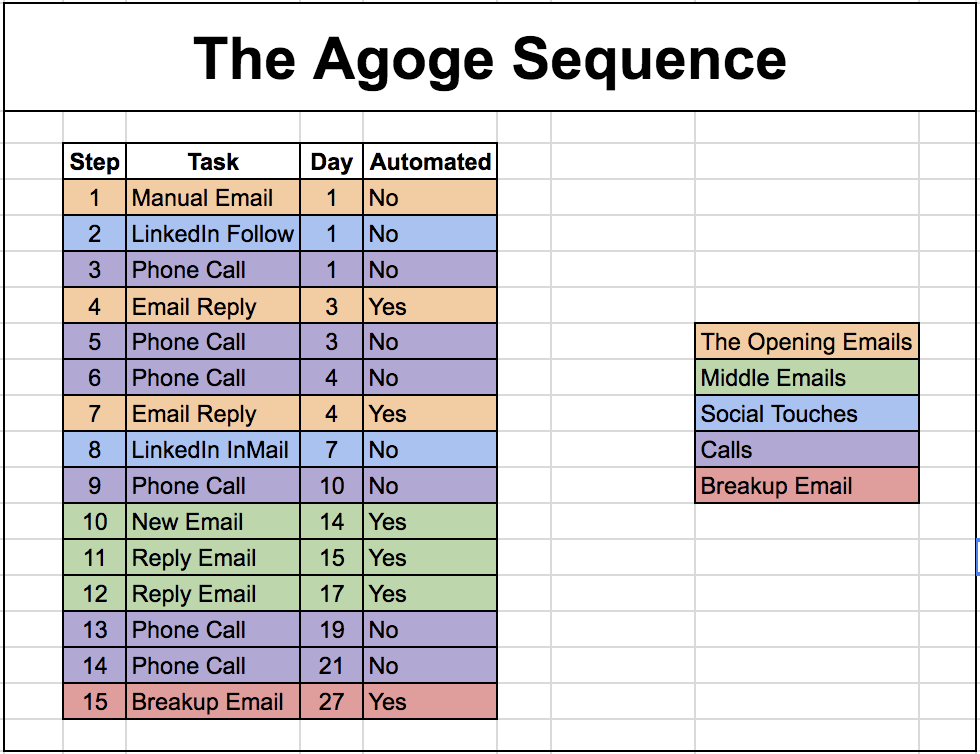
在进行冷外展时,您可以使用Agoge 序列来计时和计划您的交流。
古时序列
Agoge 序列是一种广泛使用的冷外展技术,它通过简单、公式化的方法保证高转化率。 此序列使用专门的消息传递和来自社交、电子邮件和电话的高度具体的接触组合来推动可能从未听说过您的公司的潜在客户的参与。 此外,该序列使用简短的个性化触摸来最大化您的努力结果,并使用自动节奏来继续推动结果,而无需额外的输入。
以下是其工作原理的简要概述:
消息传递
Agoge Sequence 的所有成功都建立在发送给潜在客户的第一封电子邮件的前两句话之上。 第一次外展的秘诀在于个性化第一句话并通过提及有关潜在客户、他们的角色或他们的公司的独特属性来吸引潜在客户的注意。
这个细节需要最少的时间和精力,更重要的是,向您的联系人表明您关心他们的个人问题,并且您不只是用通用的销售宣传来抨击他们。 这种定制可以通过浏览他们的公司网站、阅读他们撰写的博客文章,甚至只是查看他们的 LinkedIn 个人资料来完成。 但更重要的是,它以人类笔记开始您的互动,从而使查看者从他们典型的愤世嫉俗的态度软化到冷电子邮件。
创建个性化的第一句话后,您必须在其后加上一个句子,将第一句话与您尝试销售的产品的价值主张联系起来。 这样做的方式是将潜在客户可能遇到的问题(想想恐惧和梦想)与您的产品或服务提供的好处联系起来。 如果您可以保持简短,请在此之后提供支持信息、统计数据,甚至是客户报价。
最后,以明确的行动号召结束。 这里有些例子:
- 一个(简短的)会议请求
- 一个资源链接,他们可以通过该链接了解更多信息
- 要求用他们的行业或特定角色的知识等做出回应。
- 网络研讨会注册
- 等等。
节奏
Agoge 节奏就是通过多个来源,快速连续地多次联系您的目标。 节奏的全部意义在于表明您是一个真实的人并让您始终处于首位,同时在整个节奏中将您的消息保持在目标收件箱的顶部。
展示你是一个真实的人就是你如何有效地让你的社交媒体接触。 为此,您可以使用您在电子邮件中使用的相同类型的消息传递,但您需要确保您在他们使用的社交媒体上接触您的潜在客户。 因此,如果您的潜在客户使用 LinkedIn,请使用 LinkedIn,等等。 要继续使用 LinkedIn 示例,您可以完成多种类型的接触,例如连接请求、消息和个人资料视图,以让潜在客户考虑您和您的解决方案。
您可以通过在步骤 4 和 7 中将您的初始电子邮件“撞”回收件箱顶部,并使用“只是看看您是否收到这个......”或“有什么想法吗?” 这些简单的消息足够短,无需任何额外滚动即可使您的原始消息保持可见,使您无需额外努力即可从原始消息中获得 3 倍的里程。
您可以使用电话来保持消息非常个性化,并准确了解潜在客户的问题以及您的产品/服务如何解决这些问题。 您可以通过阅读初始电子邮件的第一行来增强记忆力来促进这一点。 然后,当你打电话给他们时,把谈话当作一个了解他们、他们的公司、他们的职位、他们的问题和机会的机会,而不是一个告诉他们为什么你的产品如此出色的机会。 你越能让潜在客户谈论自己,就越好。 这样一来,您就成为了值得信赖的资源,并且您为他们提供的价值主张将针对他们的具体问题。
最后,您可以使用“分手电子邮件”。 当您在没有响应的情况下运行整个序列并且最后一次尝试建立连接时,使用此策略。 我们喜欢把它想象成一个万岁圣母,保守的人几乎没有什么收获,冒险也没有什么损失。 您所承担的风险将取决于您正在与之交谈的潜在客户、他们的角色以及您所在行业的社会规范,但您可以采用以下一些策略:
- 搞笑。 试着说些幽默的话来打破紧张或打破你的潜在客户的戒备。
- 直截了当。 在这一点上拐弯抹角是没有意义的。 告诉他们你为什么要给他们发信息,以及你能给他们带来多少价值。
- 善解人意。 告诉他们你试图达到的配额,他们可以帮助你超越界限,或者是一个让你喘不过气来的老板。
请参见下面的 Agoge 序列示例:
6. 培养你新发现的数字关系
关于 ABM 的难点在于,当您确实获得外向潜在客户时,销售周期比获得内向潜在客户时要长得多。
结果,您获得的潜在客户可能对您的服务感兴趣,但现在不需要某些东西,或者需要先获得预算批准,或者已经有竞争解决方案,导致决策过程漫长。 这意味着您在与出境潜在客户交谈时必须调整您的期望。
不要因为他们还没准备好就推销他们。 事实上,期望从冷外展中快速销售是愚蠢的。 当然,它们确实会发生,但那些是异常值。 对外销售周期很长,您需要培养您的 ABM 潜在客户才能取得成功。 因此,您已经完成了设置 ABM 流程的所有工作。
您已经弄清楚了您的 ICP、角色、消息和节奏,并且有人感兴趣地回应了! 你现在在干什么? 很高兴您有效地定位、外展和发送信息以引起兴趣! 现在,您必须努力引导他们完成客户销售之旅。
成为资源
在 Kalungi,我们喜欢通过成为我们潜在客户的资源来做到这一点。 这可能意味着对他们进行有关行业及其产品的教育,向他们提供有关要查看哪些产品的信息,甚至告诉他们如何评估他们当前的解决方案,即使这意味着告诉他们他们不适合我们的产品. 这种方法对某些人来说似乎违反直觉。 毕竟,你为什么要把所有的时间和精力浪费在一个甚至没有表现出对你的产品或服务感兴趣的潜在客户上?
我们选择这种策略的原因是我们希望我们的客户成为他们所在行业的思想领袖,以及他们接触的任何潜在客户眼中的思想领袖。 这意味着我们的客户成为值得信赖的顾问,向他们的潜在客户展示他们是该领域的专家。 这意味着,虽然我们的客户可能不会立即获得销售,但当他们的潜在客户准备好接受新的解决方案时,我们的客户将是他们首先关注的公司,因为他们已经对他们的潜在客户建立了信誉和权威。
为潜在客户创建这些资源也非常重要,因为您需要让他们花时间与您互动。 如果他们得到回报,潜在客户更有可能回复您的电子邮件或与您联系。 想一想自己。 Would you be more inclined to accept an email from someone who was just asking you to buy their product, or someone who wanted your opinion on something and offered you information that helped you solve a professional problem, in return?
Here are a few ways that you can nurture prospects, once they've connected and expressed interest:
- Thought leadership articles (top of funnel, educational)
- Industry reports (White papers, yours or not)
- Expert interviews
- A quick sample of how your solution can add value
- 教程视频
- 时事通讯
Keep your brand top-of-mind with retargeting
One other reason to create resources and share them with your prospects is slightly more self-serving: you can use these resources to retarget your prospects after they've left your site. You can do this by placing a “pixel” on the resources from 3rd party platforms such as Google, Facebook, and LinkedIn. These pixels cookie your viewers and allow you follow them around the internet, serving them ads across millions of different sites.

Once you set up accounts with the correct channels and place pixels on the resources you plan to push people to with your outreach, you can then create simple retargeting ads that guide them further through the customer journey. These ads will take a step down the funnel and have Calls to Action that offer case studies or white paper resources on your solution or industry, to give your prospects market insights, and real-world examples of how your solution can benefit companies like theirs. It also can't hurt to throw in a bottom-of-the-funnel-facing ad here and there that guides viewers to schedule a demo or experience a free trial.
On top of just getting your logo and message in front of prospects again, retargeting ads generally perform very well, when compared to their traditional counterparts. In fact, a recent MarketLand article explained that retargeting ads often have Click-Through-Rates of “0.30%-0.95% - which is 3-10x higher than the industry average.”
However, retargeting is also a bit of a double-edged sword, so you have to be careful with how you use it. While it does boast great Click-Through Rates, it also has the propensity to irritate prospects who feel that you have invaded their privacy or took advantage of their trust in you for personal gain. As a result, it is critical that you pay close attention to who your audience is that you're serving these ads to, as well as where and how often you're delivering them. Doing this will allow you to reap the large rewards that retargeting can bestow upon your ABM campaign.
Guide your prospects down the funnel with email nurturing
A third way to cultivate your ABM relationships is to enroll them in an email nurturing campaign. You can set this up by ensuring that any form fills that you place in any of your ABM campaigns or resources a) capture an email address and b) disclaim that by filling the form out, prospects are enrolling in an email nurture program.
This way, whenever someone downloads a resource or fills out one of your campaign forms, they are automatically enrolled in an automated email nurture sequence that explains the asset they just acquired and then leads them further down the funnel towards a sale. The best part about email nurtures is that, while they do take time and effort to set up, once you have them established, they are a phenomenal way to gently lead prospects down the funnel with no additional work.
Here's an example of email nurture:
- A prospect fills out a form to download a resource and are automatically enrolled in your email nurture program.
- They are sent a 4 email sequence that delivers the resource, explains how to use it, and reinforces the value propositions of the resource.
- They are then entered into a similar email sequence for a resource that is lower down the funnel.
- This process continues until the prospect reaches the bottom of the funnel with a “schedule a demo” Call to action
Cultivating your outbound relationships requires dedication, empathy, and constant tweaking to be successful. But if you are able to create a comprehensive repository of assets and are willing to spend the time to educate and add value for your prospects, you will create a continuous pipeline of leads and resulting revenue for your business.
7. Get referrals from your ABM-sourced customers
Here is where the rubber really meets the road for your ABM campaign. After all, no one can promote your company to prospects like current customers. Your customers have been through the exact buyer's journey of many of your prospects.
Your current customers were in the prospect's shoes not too long ago, felt their pain, and looked for a solution, just like your prospects do now. This instills a type of trust in prospects that is very difficult for you to garner on your own. However, harnessing the enthusiasm of your best customers creates invaluable collateral for your prospects and shows them the difference you can make for their organizations.
恭喜! You've done all the hard work of targeting, messaging, and nurturing your prospects. Many of you would think the work is over -- but no! Now comes the most important step: Harnessing the enthusiasm of these newly acquired customers to generate even newer ones with testimonials, case studies, and referrals.
客户旅程地图
Mapping your customer journey is a crucial step in understanding the customer experience and identifying possible referral sources. The customer journey map enables you to visualize who your customers are so you can build connections and bridge the gap between sales, marketing and operations. Most importantly, it will tell you which customers are ready, and at what point are they ready to join your referral program.
When mapping your customer journey, do the following to make you're optimizing resources + including all of your inputs:
Talk to your customer success, sales and marketing teams.
While all customer-facing, each of these teams will bring different perspectives and experiences to the table. Each of these roles experiences different pain points of the customer along the buyer's journey, and can identify ways to reduce friction. For example, the customer success team might know that customers struggle with integrating your software with another product, providing you with additional insight into how to make the customer experience better for others.
Take notes of your in-depth conversations with different members from each of these teams, and weave their insights into a cohesive journey map. Make sure to keep everyone updated throughout this process + give them plenty of opportunities to see into your work and add their own perspective. They all view different parts of the customer's journey, and intersecting their insight is what creates a truly robust + strong customer journey map.
How to set up referral incentives
The best time to ask your customers for a referral is -- you guessed it -- all of the time!
Don't think you shouldn't ask for referrals right when you get a customer, though. Think about when someone buys a car -- when someone is driving it off the dealer lot, they're typically excited to tell others about the big decision they just made. They put a lot of thought and time into making this big decision, and are likely to share this with others as a positive experience.
When you're asking for referrals, make sure you research different automated referral programs. Use discount codes to facilitate a “give some, get some” transaction where your customer benefits from giving you a referral. When planning the timing of your requests, you can plan requests over 4 different times: as part of a “post-purchase survey,” a “post-go-live survey,” during an annual check-up or even when your customer pays. Regardless of when you plan this, remember that your referral campaign doesn't have a beginning or an end -- it should be a continuous process.
Wondering how to turn your current customers into lead-generators? Use referral programs to incentivize customers to bring in new leads with a focus on audience, engagement and incentive.
1. Engage your audience + Find your advocates
Focus on increasing the quality and quantity of your brand advocates by auto-enrolling customers as soon as they make a purchase to maximize your referral opportunity. Make sure you're optimizing your Net Promoter Score (NPS) to identify who your most loyal brand advocates are, and kick off the program with an announcement launched through emails and social posts to generate traction fast.
2. Increase engagement and build momentum
Once you've kicked off your referral program, continue to engage your brand advocates and keep your program top-of-mind. This means adding CTAs in your emails and social posts, encouraging your customer-facing employees to include CTAs in their email signatures, post on social channels and send dedicated emails to this campaign on a schedule. You can even add blog content and landing pages for clear messaging, so your customers have no confusion about the program.
3. Incentivize at the right time.
Make sure you're incentivizing the right behaviors at the right time by setting up a multi-event reward -- don't just reward customers for referring contacts, continue to reward them when their referrals turn into leads in your pipeline, become customers, and eventually refer to other contacts. You can automate this commission process with various referral programs. You can also offer a dual incentive by offering the brand advocate and the referee with monetary rewards, like cash or gift cards.
感言
No one tells your story better than your customers. So why not quote them directly? Testimonials harness the customer's voice and allow them to directly communicate with prospects. These assets are great for showing more qualitative attributes of your product/service like dependability, ease of use, proactiveness, customer service, etc. as well as one or two high-level performance statistics.
These marketing assets add tremendous value for future customers + prospects in your buyer's journey as middle-of-the-funnel content -- if someone's wondering about their fit with your product, hearing happy + successful customers rave about your fantastic customer service or quick turnaround times will put their worries to rest & give you an advantage over your competitors when they're making their shortlist.
When you're making testimonials, call a few of your best clients and ask them to talk about their experience with your solution -- try to highlight the pain points they've solved, the “before” and “after,” and the other benefits you've given them to make their lives and work better.
实例探究
While testimonials are human-centric and empathetic, a case study is an example of a scenario with your work to change their lives. Case studies allow you to illustrate and explain how you achieved success in a specific situation, or in this case, from your ABM campaign, so your customers or prospects can see your work in action. Proving your work and track record with a case study establishes trust, converts leads, attracts traffic through SEO, and it's a great way to write in a referral.
The importance of a case study cannot be overstated -- it's a crucial piece of content for MQLs who are on the fence and considering your solution, and others in the consideration stage of your buyer's journey. It's also important for top-of-the-funnel leads interested in learning about the general applications + ways to use a solution like yours (& see if their problem matches up to your customers), and convince other leads in the bottom of the funnel that your past customer successes make you a good fit for them.
Because you want to create content that illustrates the value of your solution to a prospective customer, ask questions that target the original problem, identify the solution and intended outcomes, extract measurable results (statistics, metrics, etc.). This will help your prospect relate to the context and reduce friction during the buyer's journey.
We recommend recording your conversations with clients to capture VOC (voice of the customer) quotes and verbatims. These can be used within the final version of the written case study to add social proof – and used in other assets like sales enablement materials and on the website to build trust. To start making your first case study, use the outline below to guide content and fill in this template.
Next steps with ABM
Now that you understand the framework and goals of account-based marketing, it's time to put your knowledge to the test. If you're still not sure where to start, remember that account-based marketing is centripetal around identifying your serviceable obtainable market (SOM) and actively pursuing them with the right content, messaging and cultivation.
It may seem overwhelming at first, but it'll get easier and easier over time. Properly executed Account-based Marketing will deliver the results you want. Just be patient & monitor your progress -- from A/B testing with outbound messaging to measuring your content's effectiveness when driving the buyer's journey.
And you know by now that your work doesn't end once you've secured those relationships -- it's extremely beneficial to nurture those relationships and encourage referrals, testimonials, case studies and verbatims that will encourage future prospects.
Thanks for reading -- happy Account-based Marketing!