
如何執行有效的基於 B2B SaaS 帳戶的營銷活動
已發表: 2021-06-16基於客戶的營銷 (ABM)是一種專注的增長戰略,其中營銷和銷售合作為一組相互識別的高價值客戶創造個性化的購買體驗。
這種 B2B 外展策略可以幫助您的公司進入新市場、攻擊新的垂直領域,甚至為即將舉行的活動或產品發布吸引潛在客戶。
然而,要執行有效的活動,ABM 需要大量的準備、多個部門之間的協調以及精確的時間執行。 如果沒有對這些領域給予適當的關注,你最終會陷入一場無效的競選活動,花費太多的錢,而對你出錯的地方幾乎沒有洞察力。
在 Kalungi,我們看到許多 B2B SaaS 公司希望通過有效的 ABM 活動來加強他們當前的營銷工作。 但是,對於經驗很少或沒有經驗的公司來說,將基於客戶的營銷活動從無到有發展到全面的潛在客戶開發工作可能會令人生畏。
如您所見,ABM 並不是一根魔杖。 相反,它是人員、流程和技術的強大組合,如果以智能方式部署,它將勝過貴公司的所有其他需求生成計劃。
如果您的 B2B SaaS 公司正在考慮開展 ABM 活動來推動和支持業務增長,請繼續閱讀以了解如何實施成功的活動。
ABM 不僅僅是對外營銷
是否應該真正將入站驅動的基於帳戶的營銷視為 ABM 尚有爭議。 然而,很明顯,現代的 ABM 方法需要在協調方法中結合入站和出站元素。 基於客戶的營銷傳統上被視為 B2B 對外銷售的總體戰略。 然而,更複雜的觀點將 ABM 視為一種包含出站和入站營銷的有針對性的策略。 更複雜的 B2B 企業也有將基於帳戶的營銷策略納入其業務模型的空間。
好消息是,啟動 SaaS ABM 不需要您拔掉現在正在做的所有事情並從頭開始。 相反,它是一種與您現有的需求生成流程一起工作的補充策略——與他們共享資源、數據、工具和技術。
基於帳戶的營銷概述
ABM 流程採用典型的銷售/營銷漏斗並將其翻轉過來,從最適合產品或服務但可能尚未準備好購買的潛在客戶開始。 然後,該策略將在整個銷售週期中培養他們,並通過推薦和口碑擴大其潛在客戶。

左側的銷售漏斗; 右側的 ABM 漏斗
因此,ABM 活動不會向大量受眾發送電子郵件和廣告並查看誰決定“選擇加入”並表現出興趣,而是選擇一小部分候選人,他們可能甚至不了解您的產品,但他們是完美的適合它。 找到這些有前途的聯繫人後,您可以通過搜索與他們具有相似品質的其他聯繫人或帳戶來擴展您的列表。 這使您可以在每次迭代中更多地了解您的頂級潛在客戶,並在優化搜索條件的同時擴展您的列表。
一旦你有了一個堅實的基礎列表,你需要通過有效的信息來吸引這些潛在客戶,這些信息與每個特定的聯繫人以及他們的恐懼和夢想交談,激勵他們與你聯繫並做出回應。 這個過程還涉及重新定位潛在客戶,並在銷售漏斗中培養他們並進行購買。
最後,一旦您有效地參與並引導了最佳潛在客戶進行購買,您需要利用他們的興趣,讓他們有機會告訴他人您有多棒。 這可能涉及推薦獎勵,或者讓他們創建自己的推薦書以吸引更多像他們這樣的客戶。
按照以下 7 個步驟執行有效的 B2B SaaS ABM 活動:
1. 建立理想的客戶檔案 (ICP)
這並不意味著您不能向符合更廣泛標準的客戶開放您的入站“網絡”,而是因為基於帳戶的營銷更像是魚叉式釣魚,您需要真正認真地了解您的目標對象。
因為這種類型的營銷完全圍繞您接觸的人展開,所以您必須選擇將從您的產品或服務中受益最多的公司,並且如果他們轉換為購買您的服務,他們將成為您的頂級客戶。 對於有效的 ABM 活動,您可以做的第一件事也是最基礎的事情是知道您需要針對誰。
許多公司喜歡擁有大量受眾,因為他們擁有的潛力,以及如果可以適當地接觸到他們可以釋放的收入。 然而,在市場營銷中,尤其是對於 B2B SaaS 公司,當你試圖取悅所有人時,你最終卻沒有取悅任何人,因為你製作的通用消息不會真正與任何人群交流。
在 Kalungi,我們喜歡為 B2B SaaS 客戶使用一個稱為理想客戶檔案 (ICP) 的框架。 該框架旨在根據一組標準識別非常適合您的產品的公司(而不是人員或聯繫人)。 我們通常將這些標準分解為過濾器和信號。 過濾器是“成敗”的標準,或者對於一家公司來說是完全必要的,而信號是“很好的”,如果公司沒有,也不會成為交易破壞者。 t 有資格獲得他們。
以下是您可以用於您的業務的潛在過濾器和信號列表:
過濾器
- 薄膜學
- 行業
- # 員工
- # 客戶
- 年度經常性收入 (ARR)
- 地理
- 組織成熟度
- 技術:
- 當前的 IT/技術/(插入您的產品領域)管理系統
- 易於與您的系統集成
- 當前程序/軟件
信號
- 薄膜學
- 增長率
- % 攪拌
- 市場份額
- 顧客評論
- 工藝學
- 自系統/IT/程序刷新以來的時間
- 使用競爭對手的產品
- 使用過時的系統
您如何為您的公司開發 ICP? 採訪一些你最好的客戶,找出哪些最容易上手、最有利可圖,或者看到你的產品最有價值,以幫助你列出這個列表。 您還可以採訪銷售、營銷、客戶成功和高管,以更深入地了解哪些客戶最適合。 一旦你完成了足夠多的這些採訪,使用你在與你交談過的最佳客戶中看到的模式,並製定你的過濾器和信號列表,並創建你的理想客戶檔案。
一旦您開發了您的 ICP,請使用這些新信息將您的可服務可尋址市場 (SAM)細化為該市場中最佳客戶的列表。 此列表將成為您整個 ABM 活動的基礎,也將成為您選擇的市場潛力或進入市場策略有效性的重要指標。
2.聯繫合適的人
如果你不知道你需要在這些公司中解決哪些人,那麼列出最好的公司名單對你沒有任何好處。 考慮到這一點,重要的是利用您從 ICP 練習中獲得的知識,並通過在這些公司中創建最多可為您帶來最大成功的角色來更進一步。
創建角色時要回答的一些問題是:
- 誰是最終購買您產品的商業決策者?
- 誰是您的第一個接觸點,您可以使用誰來讓您踏入大門?
- 誰將成為您在組織內的內部倡導者? 誰會努力確保您的服務被購買?
- 誰將成為組織內的阻礙者? 你將如何影響他們與你的產品保持一致?
- 您的服務將解決誰的問題? 誰的生活會因此而變得更好?
就像上面的 ICP 練習一樣,採訪你目前最好的客戶、銷售、營銷、客戶成功和高管,以清楚地了解這些角色是誰。 歸根結底,您應該有一個文檔,其中包含幾個不同的角色要處理,並且每個角色都有一組定義特徵。
我們使用的一些特性是:
- 人口統計
- 年齡範圍
- 職位(此角色可能擁有的頭銜列表)
- 職責或“待完成的工作”
- 心理學
- 恐懼(是什麼讓他們夜不能寐?)
- 夢想(什麼會顯著改善他們的生活?)
- 痛苦
如果你做對了,這個角色文檔會讓你深入了解組織內哪些人將成為倡導者或阻礙者,每個人關心什麼,以及如何與參與採購的不同類型的利益相關者進行溝通您的服務的決定。 一個很好的角色列表將為您提供首先聯繫誰的基礎,以及如何與客戶旅程中的每種類型的利益相關者進行溝通。
3. 制定全面的賬戶清單
建立 ABM 聯繫人列表的方法有很多種,根據您的價格點、您可以使用的工具以及您必須將列表放在一起的時間,方法可能會有很大差異。
採購清單
一種經常使用的方法是購買清單。 這樣做會生成一個包含數千個聯繫人的列表,您只需按一下按鈕即可查看。 然而,這種方法雖然速度很快,但也可能非常昂貴,花費數万到數十萬美元。 列表數據通常也可能不完整或過時。 一些列表建立公司只是間歇性地刷新他們的數據,這可能導致過時的聯繫人,從而導致尷尬的外展錯誤。
建立自己的清單
找到合適的資源來構建您的列表是關鍵。 在 Kalungi,我們建議對公共和私人在線數據庫進行廣泛搜索,您可以在其中找到最準確和最新的 ICP 和角色信息列表。
為了更好地說明這一點,讓我們假設您的產品或服務提供給移動機械業務的所有者。 移動機械師是一名汽車維修技術人員,可以將他們的工具和設備直接帶給您,並且業主與多個機械師一起管理業務。
要建立您的聯繫人列表,您可以在哪裡找到移動機械業務的聯繫信息? 最新、最完整的聯繫信息在哪裡? 除了使用搜索引擎和網站之外沒有其他選擇,例如:
- 喊叫
- 谷歌地圖
- 真正的黃頁
- 曼塔網
由於這些是您無法從中導出信息的公共數據庫,因此您需要一個工具來識別和提取 ICP 中公司的信息並手動搜索聯繫信息。 這樣做通常需要比典型 SaaS 公司能夠承受的更多時間、精力和資源。 在 Kalungi,我們的數據輸入部門專門在給定的 ICP 和角色資料中查找公司和聯繫信息。
另一種查找聯繫信息的方法是通過活動參與者慢慢建立您的聯繫人列表。 這可以通過參加通常適合您的 ICP 的活動、自行支付與會者名單或通過贊助來完成。 使用這種方法收集聯繫人需要時間,並且需要過濾以確保這些公司值得聯繫。 但是,這允許 SaaS 公司生成準確的實時聯繫人列表,供您聯繫。
銷售平台
建立外展聯繫人列表的第三種方法是通過第三方服務(如 Linkedin 的銷售導航工具)手動創建列表。
這項服務比購買清單便宜得多,但如果您有時間和帶寬來確保清單是高質量的,則可以產生與購買清單相似甚至更好的結果。
Linkedin 還可以說擁有最好的 B2B 外展聯繫人數據庫。 Sales Navigator 使您可以訪問更高級的潛在客戶搜索,允許您按公司屬性(例如員工規模和行業)過濾聯繫人。 然而,LinkedIn 本身的公司信息有限,因此很難確保聯繫人與理想客戶檔案完美契合。
卡隆吉之道
在 Kalungi,我們喜歡將現有列表(例如購買列表或多個事件列表)與 LinkedIn 和 Sales Navigator 相結合,以構建一個真正全面的列表。 現有的列表很快讓我們對市場有一個大致的了解,而 LinkedIn 信息為我們提供了最新的、精細的數據,以將每家公司與我們的 ICP 以及與我們的角色的每個聯繫人相匹配。
一旦將這些信息組合成一個有凝聚力的數據集,就可以對其進行細化,以顯示您的可服務可獲得市場(或“SOM”)到底有多大,對您的進入市場策略進行壓力測試,並用於為您的外展活動創建相關內容。
4. 創建相關內容以提高意識、考慮和轉化
現在你已經確定了你的 ICP 和 Personas,是時候與他們溝通了。 但是,您如何確保與每個人進行有效的溝通並正確展示您的解決方案可以為他們的公司帶來的價值?
秘訣在於利用您從 ICP 和角色中獲得的知識,並將其應用於客戶旅程的每個階段:意識、考慮和轉換。 對於一個有影響力的基於客戶的營銷活動,您將為每個階段創建內容,提供一般產品和公司信息以提高知名度、技術細節和定價以供考慮,以及轉換的緊迫性。 每個階段的每一條內容都應該被設計成適當地教育潛在客戶他們在客戶旅程中的位置,並將他們推向下一階段。
以下是我們為最成功的 ABM 活動創建的內容類型:
- 發送給每個角色的電子郵件(初始外展、跟進、回復等)
- 支持主要優勢、提供更多信息並便於填寫表格的登錄頁面
- 意識階段的思想領導力和博客文章
- 供考慮的產品特定頁面(定價、版本、規格等)
- 轉換階段的推薦、特價和獎勵
我們還喜歡將我們的內容組織成一個框架,展示每個客戶角色、每個漏斗階段以及適用於每個階段的內容。 這使您可以在創建一個全面的計劃來解決每個角色的同時,在整個客戶旅程中找到並填補內容空白。
建立內容存儲庫後,您應該能夠在客戶旅程的每個階段有效地聯繫每個角色,並引導他們進入銷售渠道。
5. 使用正確的消息、渠道和節奏與目標受眾建立聯繫
您如何以一種讓他們願意消費的方式向潛在客戶提供這些內容? 對於出站消息,這可能特別困難,因為您要聯繫的人可能聽說過您,也可能沒有聽說過,甚至可能不知道他們有需要解決的問題。 因此,人們對冷出站消息的懷疑程度比入站客戶旅程中的要高得多。
ABM 消息傳遞
設身處地為潛在客戶著想一分鐘。 我們都(不幸地)習慣了我們的收件箱被電子郵件廣告和冷銷售宣傳所淹沒,這將我們的注意力從我們每天需要完成的重要事情上轉移開。 結果,我們很快就會丟棄來自未知發件人的消息,該發件人只是給我們另一個推銷。 我們經常在將郵件扔進垃圾箱之前,讓收件箱中的郵件快速瀏覽一下主題(如果發件人幸運的話,也許可以看一下第一句話)。
正因為如此,您的初始出站消息需要立即通過幾個關鍵元素為讀者提供價值:
- 個性化您的信息:表明您正在單獨與他們聯繫。 與他們交流您進行了研究並知道他們是誰/他們做什麼。
- 說出他們的恐懼和夢想:使用您在上述練習中完成的角色創建信息,向讀者展示您了解他們的痛點並知道如何改善他們的生活。
- 尋求幫助:結交新朋友的最好方法是尋求他們的幫助。 雖然人們通常不願意聽取他們不認識的人的推銷,但他們更有可能向尋求幫助的人提供幫助。 他們覺得自己很重要,因為他們擁有你所沒有的知識或經驗,而且他們對幫助別人並為當天做好事感覺很好。
- 給他們一些回報:讓讀者與你互動值得。 如果人們得到回饋,他們更有可能閱讀並回复您的信息。 這可以是行業知識、有關最佳實踐的信息,或者讀者認為有價值的任何其他內容。
完成第 3 步和第 4 步並且效果很好的一個例子是在我們正在整理的一份行業白皮書中詢問潛在客戶的意見,因為我們正在尋求更多地了解潛在客戶。 這個過程涉及他們與我們的一名員工進行快速採訪,在採訪中我們詢問他們與我們的服務相關的痛點和願望。 作為回報,我們向他們承諾我們將生成的報告。 這讓潛在客戶可以了解行業格局,以及他們可以遵循的一些最佳實踐來改善他們的業務。
始終進行 (A/B) 測試
市場營銷以及許多其他事情都有一條一般規則,即您應該始終進行測試。 這種情緒在 ABM 消息傳遞中尤其如此,因為它比典型的入站消息傳遞要困難得多。 通過 ABM 消息傳遞,您可以聯繫到可能甚至不知道他們有問題的人,並試圖說服他們將別人的錢花在您身上。
正如您可以想像的那樣,這個過程可能非常困難,雖然典型的消息傳遞框架可能會為您提供要放入消息的內容,但沒有一種方法可以吸引讀者並讓他們相信您的產品的價值。 因此,您需要不斷地進行 A/B 測試,以便您可以根據數據做出決定,哪些消息有效並且應該更多地利用,哪些消息失敗並且需要從節奏中刪除。
ABM 消息傳遞通道
您可以使用多種途徑讓潛在客戶參與 ABM 活動。 事實上,任何可以用來直接與某人交流的媒介都可以得到有效利用。
為簡單起見,我們將重點介紹我們在 Kalungi 使用過的最流行的 ABM 渠道:LinkedIn、電子郵件和電話。 每種方法都有其自身的缺點和優點,但所有方法都非常有效地將您的信息傳達給正確的人,他們會接受並將他們推向漏斗。
領英
LinkedIn是 Kalungi 使用最多的 ABM 渠道,因為它具有消息傳遞功能以及豐富的列表功能。 LinkedIn 允許您免費發送最多 300 個字符的消息。 此外,當您與聯繫人聯繫時,您會立即獲得他們的所有專業信息,包括角色、職責、電子郵件,有時還包括電話號碼。
然而,LinkedIn 外展的最佳部分之一是,當你伸出手時,你被認為是一個人,而不是一個機器人。 你有一張照片、一個背景和一份簡歷,這讓你變得人性化。 由於這些因素,LinkedIn 是(如果不是)最準確和最新的 B2B 外展列表之一,因為每個人都在不斷更新他們的 LinkedIn 個人資料,以實現他們所取得的每一個重大職業里程碑。
這三個元素結合在一起,形成了一個相對便宜的工具,可以讓您有效地向目標傳達信息,了解更多關於他們的信息,並在銷售漏斗中培養他們。 此外,您需要記住,LinkedIn 存在一些限制,您每周可以發送大約 100 個連接,也就是說您希望將此頻道用於列表中最重要的聯繫人。
電子郵件
與 LinkedIn 相比,電子郵件的最大優勢在於它對初始外聯消息沒有字符限制。 你想寫多少就寫多少,完全不受限制。 然而,伴隨著這種自由,也有一些權衡。
- 由於電子郵件價格便宜、易於使用、可自動化,並且一次可以接觸到數千個聯繫人,因此幾乎所有現有的 B2B 和 B2C 營銷人員都在使用它。 這會導致上述相同的收件箱堵塞,但也會導致垃圾郵件過濾器、高水平的外展競爭以及對來自無法識別的發件人的電子郵件產生懷疑的消費者。
- 其次,如果電子郵件外展被濫用,它可能會通過將其列入黑名單對您的電子郵件域造成重大損害,這會影響您的外展、電子郵件營銷,甚至影響您與潛在客戶和現有客戶溝通的能力。
幸運的是,您可以購買Outreach.io等電子郵件工具來幫助管理您的電子郵件推廣活動。 像這樣的工具可以自動發送電子郵件、限制消息發送以規避垃圾郵件過濾器,甚至 A/B 測試您的消息,以確保您始終優化與潛在客戶的聯繫。 這些工具是有效的電子郵件外展活動的必備工具,將通過自動化成倍增加您的覆蓋面,並通過分析讓您變得更聰明。
電話
電話外展是我們合作過的最有效的外展渠道。 電話外展是迄今為止最個人化的方法。 它還讓您有機會真正了解您的潛在客戶,以及他們的恐懼和夢想,以便您可以a)確定您的產品是否適合客戶, b)知道如何快速有效地溝通您的產品對該客戶的價值。 電話如果做得好,也是一種非常人性化和有針對性的外展媒介,因為它可以讓消費者以直接適用於他們業務的方式了解您和您的公司。
雖然您可以編寫腳本和呼叫指南,但您必須單獨執行每個呼叫,如果您有幸接到電話,您必須與他們進行真正的對話,以便將他們轉換為請求更多信息或安排演示。
然而,電話外展也是最困難和最耗時的外展方法,因為它需要個性化、正確撥打每個電話所需的時間,以及跟進大多數不接聽電話的人。第一次嘗試。 因此,如果您想擁有一個有效的電話推廣計劃,您通常必須投資聘請業務發展代表團隊,並致力於努力跟踪銷售技巧和轉化指標,以確保您保持積極的投資回報率。
ABM 消息節奏
關於如何最好地接觸冷漠的前景,有許多思想流派。 然而,我們似乎最成功的序列似乎有一些共同點:
- 多種外展渠道
- 觸摸之間的小間隙
- 個性化
但是,順序和渠道將根據您在理想客戶檔案中定位的對象而改變。 如果您的產品或服務提供給大型企業,您可能不想使用短信或冷電話作為渠道。 但是,如果您的 ICP 包括當地餐館、商店等小型企業,則發短信和打電話可能更有效。
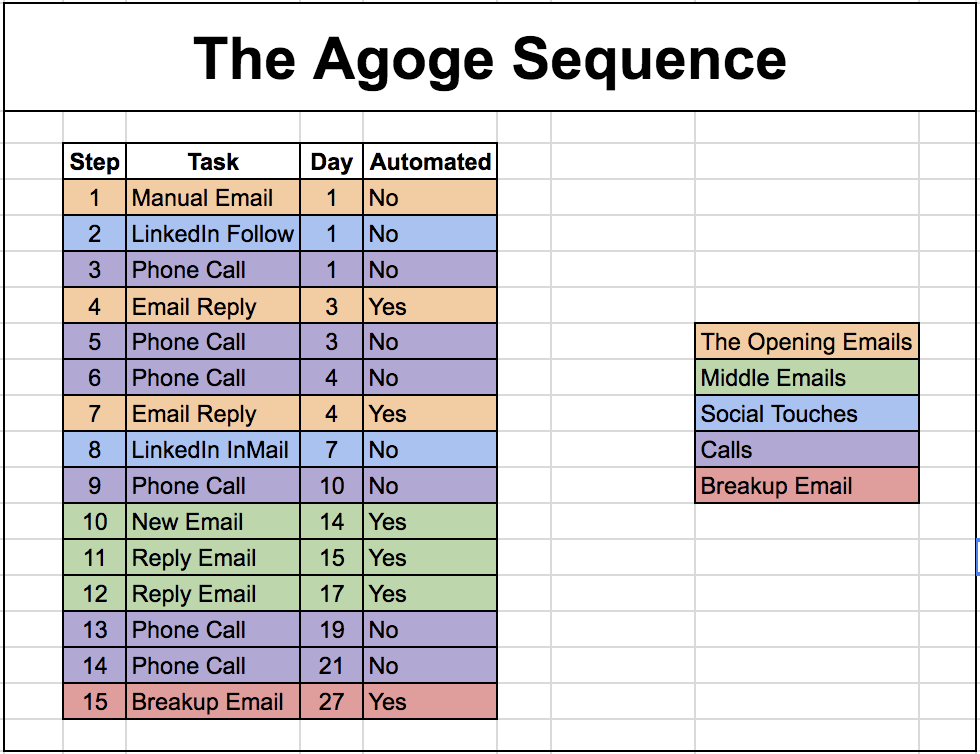
在進行冷外展時,您可以使用Agoge 序列來計時和計劃您的交流。
古時序列
Agoge 序列是一種廣泛使用的冷外展技術,它通過簡單、公式化的方法保證高轉化率。 此序列使用專門的消息傳遞和來自社交、電子郵件和電話的高度具體的接觸組合來推動可能從未聽說過您的公司的潛在客戶的參與。 此外,該序列使用簡短的個性化觸摸來最大化您的努力結果,並使用自動節奏來繼續推動結果,而無需額外的輸入。
以下是其工作原理的簡要概述:
消息傳遞
Agoge Sequence 的所有成功都建立在發送給潛在客戶的第一封電子郵件的前兩句話之上。 第一次外展的秘訣在於個性化第一句話並通過提及有關潛在客戶、他們的角色或他們的公司的獨特屬性來吸引潛在客戶的注意。
這個細節需要最少的時間和精力,更重要的是,向您的聯繫人表明您關心他們的個人問題,並且您不只是用通用的銷售宣傳來抨擊他們。 這種定制可以通過瀏覽他們的公司網站、閱讀他們撰寫的博客文章,甚至只是查看他們的 LinkedIn 個人資料來完成。 但更重要的是,它以人類筆記開始您的互動,從而使查看者從他們典型的憤世嫉俗的態度軟化到冷電子郵件。
創建個性化的第一句話後,您必須在其後加上一個句子,將第一句話與您嘗試銷售的產品的價值主張聯繫起來。 這樣做的方式是將潛在客戶可能遇到的問題(想想恐懼和夢想)與您的產品或服務提供的好處聯繫起來。 如果您可以保持簡短,請在此之後提供支持信息、統計數據,甚至是客戶報價。
最後,以明確的行動號召結束。 這裡有些例子:
- 一個(簡短的)會議請求
- 一個資源鏈接,他們可以通過該鏈接了解更多信息
- 要求用他們的行業或特定角色的知識等做出回應。
- 網絡研討會註冊
- 等等。
節奏
Agoge 節奏就是通過多個來源,快速連續地多次聯繫您的目標。 節奏的全部意義在於表明您是一個真實的人並讓您始終處於首位,同時在整個節奏中將您的消息保持在目標收件箱的頂部。
展示你是一個真實的人就是你如何有效地讓你的社交媒體接觸。 為此,您可以使用您在電子郵件中使用的相同類型的消息傳遞,但您需要確保您在他們使用的社交媒體上接觸您的潛在客戶。 因此,如果您的潛在客戶使用 LinkedIn,請使用 LinkedIn,等等。 要繼續使用 LinkedIn 示例,您可以完成多種類型的接觸,例如連接請求、消息和個人資料視圖,以讓潛在客戶考慮您和您的解決方案。
您可以通過在步驟 4 和 7 中將您的初始電子郵件“碰撞”回收件箱頂部,並使用“只是看看您是否收到這個......”或“有什麼想法嗎?” 這些簡單的消息足夠短,無需任何額外滾動即可使您的原始消息保持可見,使您無需額外努力即可從原始消息中獲得 3 倍的里程。
您可以使用電話來保持消息非常個性化,並準確了解潛在客戶的問題以及您的產品/服務如何解決這些問題。 您可以通過閱讀初始電子郵件的第一行來增強記憶力來促進這一點。 然後,當你打電話給他們時,把談話當作一個了解他們、他們的公司、他們的職位、他們的問題和機會的機會,而不是一個告訴他們為什麼你的產品如此出色的機會。 你越能讓潛在客戶談論自己,就越好。 這樣一來,您就會成為值得信賴的資源,並且您向他們提供的價值主張將針對他們的具體問題。
最後,您可以使用“分手電子郵件”。 當您在沒有響應的情況下運行整個序列並且最後一次嘗試建立連接時,使用此策略。 我們喜歡把它想像成一個冰雹瑪麗,保守的人幾乎沒有什麼收穫,冒險也沒有什麼損失。 您所承擔的風險將取決於您正在與之交談的潛在客戶、他們的角色以及您所在行業的社會規範,但您可以採用以下一些策略:
- 搞笑。 試著說些幽默的話來打破緊張或打破你的潛在客戶的戒備。
- 直截了當。 在這一點上拐彎抹角是沒有意義的。 告訴他們你為什麼要給他們發信息,以及你能給他們帶來多少價值。
- 善解人意。 告訴他們你試圖達到的配額,他們可以幫助你超越界限,或者是一個讓你喘不過氣來的老闆。
請參見下面的 Agoge 序列示例:
6. 培養你新發現的數字關係
ABM 的難點在於,當您確實獲得外向潛在客戶時,銷售週期比獲得內向潛在客戶時要長得多。
結果,您獲得的潛在客戶可能對您的服務感興趣,但現在不需要某些東西,或者需要先獲得預算批准,或者已經有競爭解決方案,導致決策過程漫長。 這意味著您在與出境潛在客戶交談時必須調整您的期望。
不要因為他們還沒準備好就推銷他們。 事實上,期望從冷外展中快速銷售是愚蠢的。 當然,它們確實會發生,但那些是異常值。 對外銷售週期很長,您需要培養您的 ABM 潛在客戶才能取得成功。 因此,您已經完成了設置 ABM 流程的所有工作。
您已經弄清楚了您的 ICP、角色、消息和節奏,並且有人感興趣地回應了! 你現在在幹什麼? 很高興您有效地定位、外展和發送信息以引起興趣! 現在,您必須努力引導他們完成客戶銷售之旅。
成為資源
在 Kalungi,我們喜歡通過成為我們潛在客戶的資源來做到這一點。 這可能意味著對他們進行有關行業及其產品的教育,向他們提供有關要查看哪些產品的信息,甚至告訴他們如何評估他們當前的解決方案,即使這意味著告訴他們他們不適合我們的產品. 這種方法對某些人來說似乎違反直覺。 畢竟,你為什麼要把所有的時間和精力浪費在一個甚至沒有對你的產品或服務表現出濃厚興趣的潛在客戶身上呢?
我們選擇這種策略的原因是我們希望我們的客戶成為他們所在行業的思想領袖,並且在他們接觸的任何潛在客戶眼中。 這意味著我們的客戶成為值得信賴的顧問,向他們的潛在客戶展示他們是該領域的專家。 這意味著,雖然我們的客戶可能不會立即獲得銷售,但當他們的潛在客戶準備好接受新的解決方案時,我們的客戶將是他們首先關注的公司,因為他們已經對他們的潛在客戶建立了信譽和權威。
為潛在客戶創建這些資源也非常重要,因為您需要讓他們花時間與您互動。 如果潛在客戶得到回報,他們更有可能回复您的電子郵件或與您聯繫。 Think about yourself for a second. Would you be more inclined to accept an email from someone who was just asking you to buy their product, or someone who wanted your opinion on something and offered you information that helped you solve a professional problem, in return?
Here are a few ways that you can nurture prospects, once they've connected and expressed interest:
- Thought leadership articles (top of funnel, educational)
- Industry reports (White papers, yours or not)
- Expert interviews
- A quick sample of how your solution can add value
- 教程視頻
- 時事通訊
Keep your brand top-of-mind with retargeting
One other reason to create resources and share them with your prospects is slightly more self-serving: you can use these resources to retarget your prospects after they've left your site. You can do this by placing a “pixel” on the resources from 3rd party platforms such as Google, Facebook, and LinkedIn. These pixels cookie your viewers and allow you follow them around the internet, serving them ads across millions of different sites.

Once you set up accounts with the correct channels and place pixels on the resources you plan to push people to with your outreach, you can then create simple retargeting ads that guide them further through the customer journey. These ads will take a step down the funnel and have Calls to Action that offer case studies or white paper resources on your solution or industry, to give your prospects market insights, and real-world examples of how your solution can benefit companies like theirs. It also can't hurt to throw in a bottom-of-the-funnel-facing ad here and there that guides viewers to schedule a demo or experience a free trial.
On top of just getting your logo and message in front of prospects again, retargeting ads generally perform very well, when compared to their traditional counterparts. In fact, a recent MarketLand article explained that retargeting ads often have Click-Through-Rates of “0.30%-0.95% - which is 3-10x higher than the industry average.”
However, retargeting is also a bit of a double-edged sword, so you have to be careful with how you use it. While it does boast great Click-Through Rates, it also has the propensity to irritate prospects who feel that you have invaded their privacy or took advantage of their trust in you for personal gain. As a result, it is critical that you pay close attention to who your audience is that you're serving these ads to, as well as where and how often you're delivering them. Doing this will allow you to reap the large rewards that retargeting can bestow upon your ABM campaign.
Guide your prospects down the funnel with email nurturing
A third way to cultivate your ABM relationships is to enroll them in an email nurturing campaign. You can set this up by ensuring that any form fills that you place in any of your ABM campaigns or resources a) capture an email address and b) disclaim that by filling the form out, prospects are enrolling in an email nurture program.
This way, whenever someone downloads a resource or fills out one of your campaign forms, they are automatically enrolled in an automated email nurture sequence that explains the asset they just acquired and then leads them further down the funnel towards a sale. The best part about email nurtures is that, while they do take time and effort to set up, once you have them established, they are a phenomenal way to gently lead prospects down the funnel with no additional work.
Here's an example of email nurture:
- A prospect fills out a form to download a resource and are automatically enrolled in your email nurture program.
- They are sent a 4 email sequence that delivers the resource, explains how to use it, and reinforces the value propositions of the resource.
- They are then entered into a similar email sequence for a resource that is lower down the funnel.
- This process continues until the prospect reaches the bottom of the funnel with a “schedule a demo” Call to action
Cultivating your outbound relationships requires dedication, empathy, and constant tweaking to be successful. But if you are able to create a comprehensive repository of assets and are willing to spend the time to educate and add value for your prospects, you will create a continuous pipeline of leads and resulting revenue for your business.
7. Get referrals from your ABM-sourced customers
Here is where the rubber really meets the road for your ABM campaign. After all, no one can promote your company to prospects like current customers. Your customers have been through the exact buyer's journey of many of your prospects.
Your current customers were in the prospect's shoes not too long ago, felt their pain, and looked for a solution, just like your prospects do now. This instills a type of trust in prospects that is very difficult for you to garner on your own. However, harnessing the enthusiasm of your best customers creates invaluable collateral for your prospects and shows them the difference you can make for their organizations.
恭喜! You've done all the hard work of targeting, messaging, and nurturing your prospects. Many of you would think the work is over -- but no! Now comes the most important step: Harnessing the enthusiasm of these newly acquired customers to generate even newer ones with testimonials, case studies, and referrals.
客戶旅程地圖
Mapping your customer journey is a crucial step in understanding the customer experience and identifying possible referral sources. The customer journey map enables you to visualize who your customers are so you can build connections and bridge the gap between sales, marketing and operations. Most importantly, it will tell you which customers are ready, and at what point are they ready to join your referral program.
When mapping your customer journey, do the following to make you're optimizing resources + including all of your inputs:
Talk to your customer success, sales and marketing teams.
While all customer-facing, each of these teams will bring different perspectives and experiences to the table. Each of these roles experiences different pain points of the customer along the buyer's journey, and can identify ways to reduce friction. For example, the customer success team might know that customers struggle with integrating your software with another product, providing you with additional insight into how to make the customer experience better for others.
Take notes of your in-depth conversations with different members from each of these teams, and weave their insights into a cohesive journey map. Make sure to keep everyone updated throughout this process + give them plenty of opportunities to see into your work and add their own perspective. They all view different parts of the customer's journey, and intersecting their insight is what creates a truly robust + strong customer journey map.
How to set up referral incentives
The best time to ask your customers for a referral is -- you guessed it -- all of the time!
Don't think you shouldn't ask for referrals right when you get a customer, though. Think about when someone buys a car -- when someone is driving it off the dealer lot, they're typically excited to tell others about the big decision they just made. They put a lot of thought and time into making this big decision, and are likely to share this with others as a positive experience.
When you're asking for referrals, make sure you research different automated referral programs. Use discount codes to facilitate a “give some, get some” transaction where your customer benefits from giving you a referral. When planning the timing of your requests, you can plan requests over 4 different times: as part of a “post-purchase survey,” a “post-go-live survey,” during an annual check-up or even when your customer pays. Regardless of when you plan this, remember that your referral campaign doesn't have a beginning or an end -- it should be a continuous process.
Wondering how to turn your current customers into lead-generators? Use referral programs to incentivize customers to bring in new leads with a focus on audience, engagement and incentive.
1. Engage your audience + Find your advocates
Focus on increasing the quality and quantity of your brand advocates by auto-enrolling customers as soon as they make a purchase to maximize your referral opportunity. Make sure you're optimizing your Net Promoter Score (NPS) to identify who your most loyal brand advocates are, and kick off the program with an announcement launched through emails and social posts to generate traction fast.
2. Increase engagement and build momentum
Once you've kicked off your referral program, continue to engage your brand advocates and keep your program top-of-mind. This means adding CTAs in your emails and social posts, encouraging your customer-facing employees to include CTAs in their email signatures, post on social channels and send dedicated emails to this campaign on a schedule. You can even add blog content and landing pages for clear messaging, so your customers have no confusion about the program.
3. Incentivize at the right time.
Make sure you're incentivizing the right behaviors at the right time by setting up a multi-event reward -- don't just reward customers for referring contacts, continue to reward them when their referrals turn into leads in your pipeline, become customers, and eventually refer to other contacts. You can automate this commission process with various referral programs. You can also offer a dual incentive by offering the brand advocate and the referee with monetary rewards, like cash or gift cards.
感言
No one tells your story better than your customers. So why not quote them directly? Testimonials harness the customer's voice and allow them to directly communicate with prospects. These assets are great for showing more qualitative attributes of your product/service like dependability, ease of use, proactiveness, customer service, etc. as well as one or two high-level performance statistics.
These marketing assets add tremendous value for future customers + prospects in your buyer's journey as middle-of-the-funnel content -- if someone's wondering about their fit with your product, hearing happy + successful customers rave about your fantastic customer service or quick turnaround times will put their worries to rest & give you an advantage over your competitors when they're making their shortlist.
When you're making testimonials, call a few of your best clients and ask them to talk about their experience with your solution -- try to highlight the pain points they've solved, the “before” and “after,” and the other benefits you've given them to make their lives and work better.
實例探究
While testimonials are human-centric and empathetic, a case study is an example of a scenario with your work to change their lives. Case studies allow you to illustrate and explain how you achieved success in a specific situation, or in this case, from your ABM campaign, so your customers or prospects can see your work in action. Proving your work and track record with a case study establishes trust, converts leads, attracts traffic through SEO, and it's a great way to write in a referral.
The importance of a case study cannot be overstated -- it's a crucial piece of content for MQLs who are on the fence and considering your solution, and others in the consideration stage of your buyer's journey. It's also important for top-of-the-funnel leads interested in learning about the general applications + ways to use a solution like yours (& see if their problem matches up to your customers), and convince other leads in the bottom of the funnel that your past customer successes make you a good fit for them.
Because you want to create content that illustrates the value of your solution to a prospective customer, ask questions that target the original problem, identify the solution and intended outcomes, extract measurable results (statistics, metrics, etc.). This will help your prospect relate to the context and reduce friction during the buyer's journey.
We recommend recording your conversations with clients to capture VOC (voice of the customer) quotes and verbatims. These can be used within the final version of the written case study to add social proof – and used in other assets like sales enablement materials and on the website to build trust. To start making your first case study, use the outline below to guide content and fill in this template.
Next steps with ABM
Now that you understand the framework and goals of account-based marketing, it's time to put your knowledge to the test. If you're still not sure where to start, remember that account-based marketing is centripetal around identifying your serviceable obtainable market (SOM) and actively pursuing them with the right content, messaging and cultivation.
It may seem overwhelming at first, but it'll get easier and easier over time. Properly executed Account-based Marketing will deliver the results you want. Just be patient & monitor your progress -- from A/B testing with outbound messaging to measuring your content's effectiveness when driving the buyer's journey.
And you know by now that your work doesn't end once you've secured those relationships -- it's extremely beneficial to nurture those relationships and encourage referrals, testimonials, case studies and verbatims that will encourage future prospects.
Thanks for reading -- happy Account-based Marketing!